Wednesday, April 3, 2013

Restaurant review, The Lincoln Dining Room.


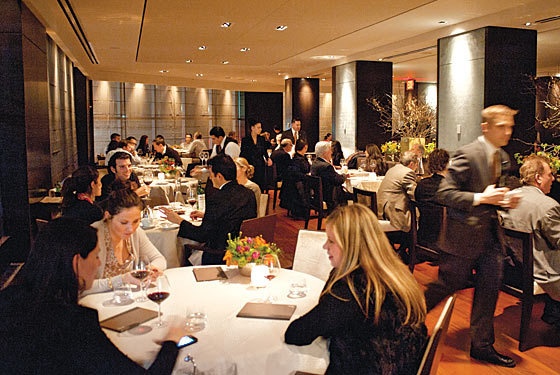
Who beamed us aboard the Starship Enterprise?” muttered one of the suburban voyagers at my table as we waited for our cocktails to arrive at Lincoln Ristorante, the dazzling postmodern dining palace that opened earlier this fall at the northern end of the newly refurbished Lincoln Center. Peering from our darkened corner banquette, we could see all sorts of strange, unearthly sights. Unlike the stylish, dungeonlike restaurants downtown, this one was as big as a private-jet hangar and sheathed largely in glass. The gleaming, state-of-the-art kitchen was also partially glass-enclosed, and manned, like the deck of Captain James T. Kirk’s starship, by some of the universe’s top talent, led by Thomas Keller’s famously cerebral, Spocklike former lieutenant Jonathan Benno, dressed in crisply pressed chef’s whites. The ceiling was covered in polished mahogany and canted at dramatic angles like a great sweeping strip of origami, and all around us, as we sipped our $14 Negronis, the huge white theater buildings glittered and glowed like giant planets in the evening sky.

This kind of theatrical spectacle has been a dim memory lately, in this burger-ravaged, postcrash metropolis. So you have to give the proprietors (the giant Patina Restaurant Group, in tandem with Lincoln Center) credit for thinking on such a grand, even majestic, scale. Unlike other ambitious New York restaurants of recent vintage, this 50-table operation isn’t housed in an old meatpacking plant, or a battered Brooklyn townhouse, or in the back of a formerly posh hotel. It resides in its own multilevel, $20 million “pavilion,” outfitted from scratch (by the architectural firm Diller Scofidio + Renfro, which also oversaw the Lincoln Center renovation) with a marble bar and three separate dining sections—one by the kitchen; one facing south, overlooking the theater spaces; and the other to the west. The wine tower, too, is made with glass, the chairs are covered in cream-colored faux leather, and if you wish to digest your meal in a more bucolic atmosphere, you can do that on the roof, which is covered in a carefully manicured meadow of grass.

Read more at http://nymag.com/

Tuesday, April 2, 2013

Restaurant review, High Thai.


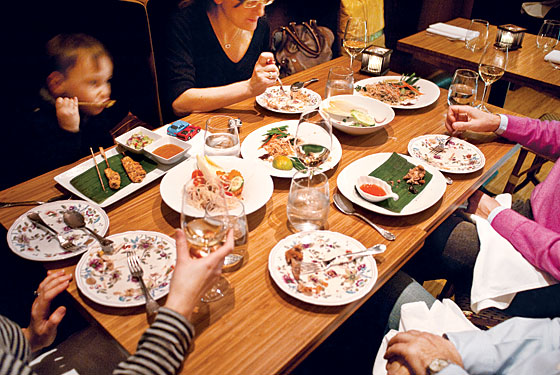
Is this really Harold’s restaurant?” exclaimed one of my slightly starstruck out-of-town guests as we settled down to dinner at Kin Shop, the deceptively unassuming “contemporary Thai” restaurant that opened a month or so ago among the jumble of nail salons and Korean delis on lower Sixth Avenue in the Village. The Harold in question is Harold Dieterle, whom my guest (along with millions of other Top Chef viewers) knows as the original (and easily most talented) winner to emerge from that Bravo megafranchise. But despite Dieterle’s triumph in the histrionic realm of reality TV, there’s never been anything garish or self-promoting about his cooking or style. Like his first West Village restaurant, Perilla, Kin Shop exudes an unassuming, carefully calibrated, even neighborly feeling. The modest space is colored in soothing shades of jade. Nothing costs more than $25. And about the closest thing you’ll find to a glamorous signature cocktail is a glass of cool artisanal gin splashed with house-brined Thai pickle juice.

Read more at http://nymag.com/

Restaurant review, Watch Your Back, Woodside.


So how does a cuisine beloved by chefs and assorted ragged outer-borough chowhounds turn into a full-fledged Manhattan restaurant boomlet more or less overnight? That was the question that the grateful, slightly befuddled Thai-food scholars at my table pondered as we sat down to dinner at Lotus of Siam, the second prominent Thai-style restaurant to open in Manhattan in the last two months. We’d gathered, just weeks before, at Harold Dieterle’s accomplished West Village establishment Kin Shop, where the tables were jammed with people feasting on goat-neck curry and squid-ink soup. At this new restaurant, on the corner of 9th Street and Fifth Avenue, the tables were unaccountably jammed as well. The scholars stared in wonder at the menu, which contained fancy Alsatian wines, tongue-twisting classics like tom kha goong and nam prik hed, and even a great, football-size red snapper, fried whole, as in the kitchens of Bangkok, and smothered in drifts of basil and chiles.

Read more at http://nymag.com/
Restaurant review, A Simple Italian White,


So, what do you do for an encore if you’re Michael White? Over the past three years, no chef in the city has been on a more impressive run than the great pasta savant from the wilds of Wisconsin. While his competitors in the upper echelons of Italian cooking have been opening populist food halls and desperately concocting recipes for meatball sliders, White and his partners have been launching one ambitious high-profile hit restaurant after the next. First came the Northern Italian establishment Alto, which White turned, more or less overnight, into one of the top five Italian restaurants in town; then came the popular Tudor City pasta destination Convivio. Last year, in the teeth of the Great Recession, when restaurants all over were furiously battening down the hatches, they opened the grandiose (and, except by me, lavishly praised) midtown seafood palace Marea, where White demonstrated his facility with more-refined ingredients like lobster tails, dainty fish crudi, and caviar.

Read more at http://nymag.com/

Monday, April 1, 2013

Restaurant review, Post-Recession Italian.


Shea Gallante’s polished new Italian restaurant, Ciano, which has been doing a brisk business since it opened in November in the Flatiron district, feels at first like a very familiar kind of place. The taverna-style space on East 22nd Street (last occupied by the Tuscan restaurant Beppe) exudes the kind of well-worn, homey charm that’s made Italian food the default fine-dining choice of our comfort-obsessed era. The tables are covered in white linen, and the walls and banquettes are colored in hues of brick orange and brown. The wait staff wear gently rumpled jackets and ties, and several of them speak with accents that may or may not be from Milan or Rome. There are veal meatballs on the menu, and bowls of rustic-sounding Tuscan bean ragù. The bread is baked in-house and warmed in a roaring fireplace, and on winter evenings, the snug, toasty dining room fills with the pleasant aroma of wood smoke, as if on cue.

But Gallante, who made his reputation running kitchens for David Bouley and was the chef at the star-crossed but well-reviewed boom-era, wine-focused restaurant Cru, has his own highly particular vision of rustic-style, farm-to-table Italian cooking in mind. The meatballs are as big as plums and almost as soft, and they come to the table in a pool of smooth white polenta and dusted with shavings of Pecorino touched with truffles. The artichoke salad (with cherry tomatoes and bits of smoked ricotta) looks less like a country salad than a delicately arranged (and quite delicious) work of food art. The perfectly seared scallops in my antipasto were shipped in from Nantucket, and if you order the charcuterie board, you’ll find that the usual assortment of salumi and hams is enlivened with elegant little blocks of pâté made from chicken livers and calves’ tongues.

Read more at http://nymag.com/

Restaurant review, The New Toque in Town.


Even the most gifted, virtuoso cooks endure periods of apprenticeship and youthful uncertainty before being recognized as truly great. But for Marcus Samuelsson, this coming-of-age tale seems to be unspooling in reverse. The Ethiopian-born chef, who learned to cook from his adoptive Swedish grandmother, emerged on the culinary stage more or less fully formed as the award-winning chef at the Scandinavian restaurant Aquavit at the precocious age of 24. Since then he’s dabbled in numerous projects, with varying degrees of success. He’s experimented with Japanese cooking (at the doomed Riingo) and African fusion (at the doomed Merkato 55). He’s starred on TV shows (he won Top Chef Masters last year) and traveled the globe writing cookbooks. But as Samuelsson hops restlessly from one adventure to the next, there’s a sense that this hypertalented cook is still trying to translate his early success into a lasting culinary voice and style.

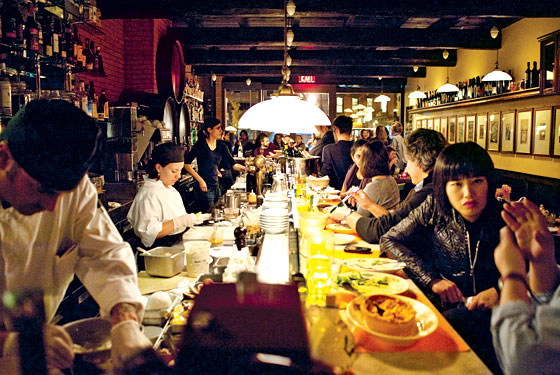
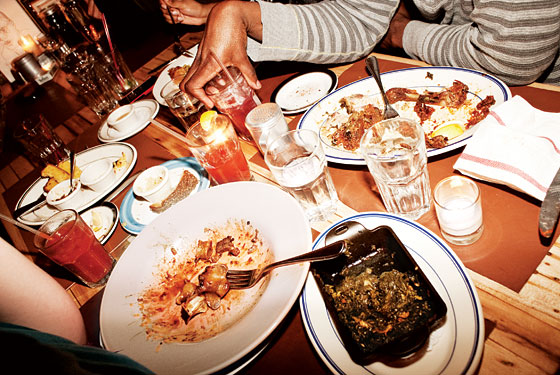
He may have found it, finally, at his long-delayed, eagerly awaited new restaurant, Red Rooster Harlem, which opened about a month ago down the block from Sylvia’s on Lenox Avenue off 125th Street. This is Samuelsson’s first venture into neighborhood dining (he lives in Harlem), and, tellingly, also the first restaurant he’s operated separately from his partners at Aquavit. The menu is filled with home-cooked favorites from Stockholm (gravlax, Swedish meatballs) and Harlem (mac and cheese, fried chicken, oxtail stew), and the elegantly appointed room has been designed with comfort in mind. The walls are decorated with tastefully curated art pieces (many by Harlem artists) and assorted neighborhood artifacts (the restaurant is named for a famous Harlem speakeasy). A bountiful gospel brunch is served on Sundays, and a stout Red Rooster burger is available at lunch. And if you want a cup of Scandinavian mulled wine to warm you up on a snowy winter’s evening, you can get that too.

Read more at http://nymag.com/

Restaurant review, Pale by Comparison.


So which comes first in the making of a polished, successful restaurant, the restaurateur or the chef? It’s the eternal chicken-and-egg question in fine-dining circles, and the great pasta savant Michael White, who’s been opening upscale trattorias around town lately like so many Subway franchises, is currently putting the query to the test. Like Mario Batali did with his partners the Bastianichs, White rose to prominence under the steadying influence of Chris Cannon, a restaurant man of the old school. With Cannon presiding over the front of the house and White twirling out inventive Italian recipes in the kitchen, they launched Convivio, in Tudor City; the fine Northern Italian restaurant Alto, in midtown; and the grand, recession-proof seafood palace Marea, on Central Park South, to (mostly) glowing reviews. But late last year, the partners went through a messy breakup, and since then, White, with the backing of the financier Ahmass Fakahany, has been frenetically expanding his empire on his own.

White’s first official solo venture was the casual downtown taverna Osteria Morini, which Cannon helped supervise (he built the wine list and consulted on the décor) before dropping out in the late stages. Now comes Ai Fiori (“Among the Flowers”), a more opulent but much more conventional ­restaurant, which opened shortly after Morini in the monolithic new Setai Fifth Avenue hotel (and residences) near the Empire State Building. Like lots of hotel restaurants, this one occupies an awkward, slightly tortured space, which you get to from the lobby, up a flight of twisting marble stairs. As at Marea (which White retained in the divorce), the bar here is made with imported polished stone (onyx at the former, marble at the latter). But unlike at Marea, the dining room is colored in gloomy shades of brown and green, and, because the curtains are drawn in the evenings to obscure the trinket shops along Fifth Avenue, there is no view.

Read more at http://nymag.com/